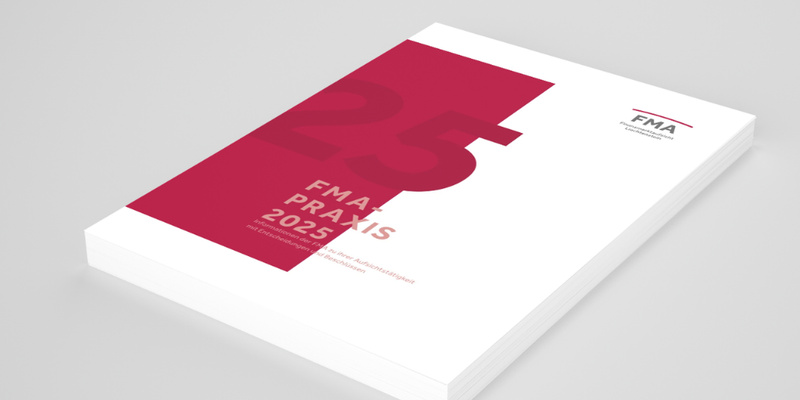
FMA Provides Information on Its Supervisory Practices
In one case, the FMA ordered a bank to restore compliance with the law within the meaning of Art. 63 of the Banking Act in two respects. First, the bank was required to ensure that a member of the board of directors met, on an individual basis, the requirements for ensuring proper business conduct. To this end, the FMA specified the training courses and examinations that the board member must successfully complete in 2025 and 2026. Second, the bank was required to ensure that the board of directors, as a body, consists of at least one-third independent members and thus collectively meets the requirements for ensuring sound business operations. This decision is of particular significance for the FMA, as this is the first time the FMA has determined—in relation to a bank—that a board member lacks the necessary individual professional qualifications and that the board of directors, as a collective body, lacks the necessary collective suitability, and has demanded that the lawful status be restored.
Another case concerned the question of whether an asset management company had an adequate domestic place of business as well as a functioning on-site administration. In a complex proceeding involving several on-site inspections at a former address of the company, the FMA determined that the company did not have a domestic place of business that met legal requirements and that the management was not actually carrying out the corresponding workload at the company’s head office. The equipment in the alleged offices, including computers and file storage, was completely inadequate. The FMA also considered it significant that the company had rented a “shared office.” However, this in no way met the requirements of the VVG, which stipulates that an asset management company must have an adequate domestic place of business. The VVG requires that asset management companies have office space that is physically separated from third parties, lockable, and equipped with sufficient workstations for all employees. External persons must not have access to business documents or client files. Compliance with the law has since been restored, and both the administrative and administrative penalty proceedings have been concluded.
In another case , the FMA determined that such serious irregularities had arisen at an insurance company that they would jeopardize the interests of the insured if the company were to continue its business operations. By order, the FMA revoked the company’s license for all of its activities. The company was ordered to settle all existing insurance contracts without delay or to transfer them to another suitable insurance company. The company filed an appeal against the FMA’s order with the FMA-BK. The FMA-BK dismissed the appeal. The company then filed an appeal against the FMA-BK’s decision with the VGH. The VGH dismissed the appeal and upheld the contested decision.
In 2025, the FMA concluded 75 enforcement proceedings with final and binding decisions. Of the 75 concluded proceedings, 30 were administrative proceedings, 42 were administrative penalty proceedings, and three were combined proceedings. As of January 1, 2026, 37 proceedings were pending. Of the 75 concluded proceedings, 17 ended with a dismissal of the case (in some instances following the final imposition of measures); in 34 cases, measures were imposed by simple letter; seven ended with a final order, seven with voluntary compliance, and ten with an administrative fine or an administrative penalty fine. During the reporting period, fines totaling CHF590,000became final in 17 different proceedings.
This content has been translated using a fully automated machine translation tool. Some content may not be accurately translated. More information.
Back to Overview