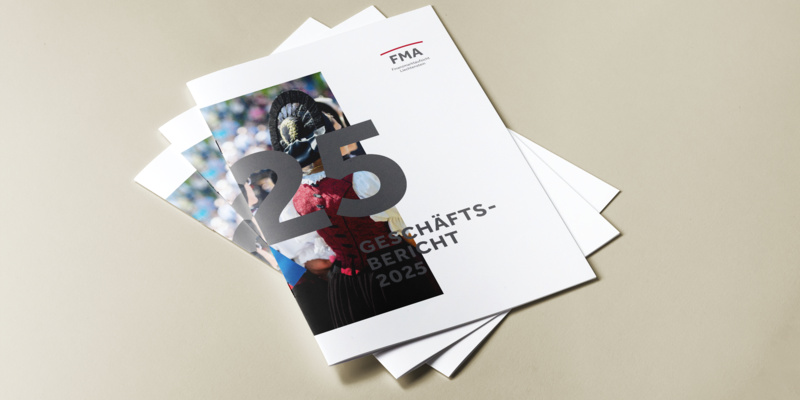
FMA publishes Annual Report 2025
- The Financial Market Authority (FMA) Liechtenstein has published its Annual Report 2025 in German. The english version will be published later this year.
- The Liechtenstein financial sector once again proved stable against the backdrop of geopolitical developments.
- New intermediaries have been participating in the Liechtenstein financial center since the end of 2025 and beginning of 2026. A mortgage bond institution and several crypto asset service providers were licensed for the first time.
- The crypto asset service providers are registered under Regulation (EU) 2023/114 on markets in crypto assets (MiCAR), which came into force at the beginning of 2025.
- The DORA Implementation Act also came into force in January 2025. In addition, the legal framework for the supervision of banks and investment firms was completely revised and the system of national laws was adapted to the regulatory system of EEA law. The new legal framework came into force on February 1, 2025.
- The FMA has always endeavored to reduce bureaucratic hurdles and increase efficiency. there will be a particular focus on this in 2026. A project was launched for this purpose at the end of 2025.
The FMA provides detailed information on events in the Liechtenstein financial centre over the past year from a supervisory perspective in its Annual Report.
The year 2025 was characterized by a challenging macroeconomic environment. Ongoing geopolitical tensions, increasing protectionist tendencies and a progressive fragmentation of global trade weighed on global economic development and led to weak investment and growth momentum overall. Nevertheless, the financial center remained stable from a macroeconomic perspective.
Supervision and regulation
Supervisory activities focused on ICT risks, combating money laundering and compliance with foreign sanctions. The reporting year was also characterized by the further development of the supervisory and regulatory framework. The entry into force of important European legal acts - including Regulation (EU) 2023/1114 on markets in crypto-assets (MiCAR) and the DORA Implementation Act - laid important foundations for a financial system that remains resilient and fit for the future.
New authorization categories were also created when MiCAR came into force. In December 2025, the first crypto-asset service providers (CASPs) in Liechtenstein were authorized to provide activities in accordance with MiCAR. CASPs may provide services in connection with crypto assets. This includes, for example, the safekeeping and administration of crypto assets for clients. Liechtenstein is therefore one of the 18 EEA states that have already issued licenses in accordance with MiCAR.
At the beginning of 2026, a mortgage bond institution was also licensed in Liechtenstein for the first time. A Pfandbrief institution is an institution with a limited scope of business that is licensed to issue Pfandbriefe for the purpose of refinancing its members. Only banks that are licensed under the Banking Act and have their registered office in Liechtenstein can be members of a Pfandbrief institution. Pfandbriefe are proven and valuable instruments for the stable and crisis-resistant refinancing of banks and thus strengthen the stability of Liechtenstein's financial center. The basis for the license was the creation of the Pfandbrief Act in December 2024.
Enforcement
In 2025, the FMA concluded 75 legally binding enforcement proceedings. Of the 75 proceedings concluded, 30 were administrative proceedings, 42 were administrative penal proceedings and three were combined proceedings. 37 proceedings were pending as at January 1, 2026. Of the 75 concluded proceedings, 17 ended with the proceedings being discontinued (in some cases after the legally binding imposition of measures), in 34 cases measures were imposed by means of a simple letter, seven ended with a final ruling, seven with a submission and ten with an administrative ban or administrative penalty ban.
In the reporting period, fines totaling CHF 590,000 became legally binding in 17 different proceedings. In a further three proceedings, fines of CHF 60,000 were imposed, but these are not yet legally binding. The amount will go to the state coffers. The majority of the fines (13) were imposed due to violations of the provisions of the Due Diligence Act. Other fines related in particular to breaches of conduct of business rules, reporting obligations and breaches of risk management provisions.
Company
Efficiency, a lean state and non-excessive bureaucracy and regulation are key factors for Liechtenstein's international competitiveness. The FMA has also been striving for a long time to reduce bureaucratic hurdles and increase efficiency. In view of a continuously growing portfolio of tasks and new regulatory requirements, the Supervisory Board issued a project mandate in December 2025 with which the FMA is systematically identifying further potential for optimization and simplification. The aim is to review regulatory requirements, processes and internal procedures for proportionality and effectiveness. The aim is to reduce the burden on supervised institutions and ensure that the FMA performs its tasks efficiently in the long term.
This content has been translated using a fully automated machine translation tool. Some content may not be accurately translated. More information.
An english version of the Annual Report will be published later this year.
Back to Overview